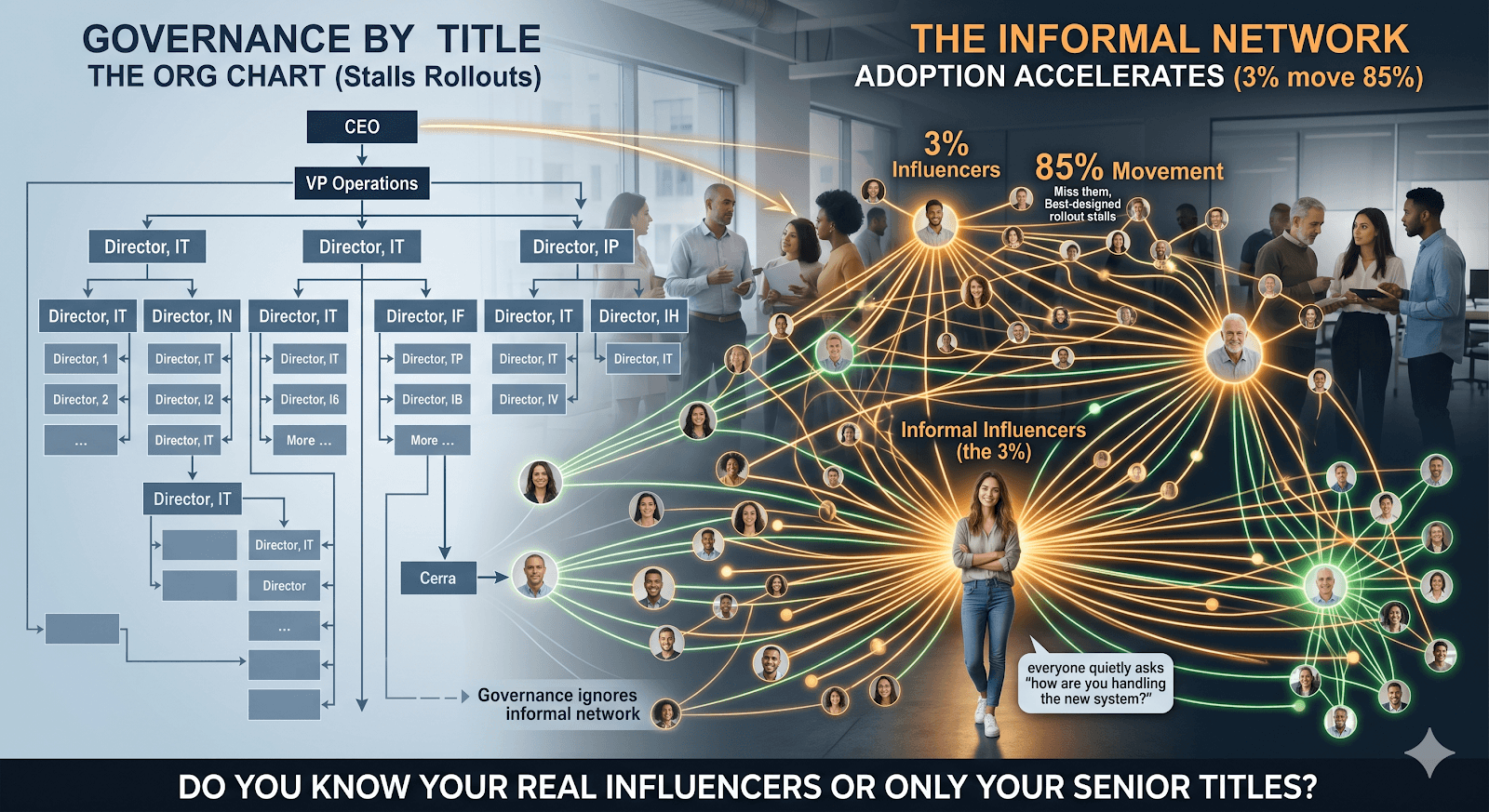
Your governance committee looks right on paper. The names are senior, the roles are recognizable, and the charter is signed. But if the people everyone actually listens to were never part of the conversation, the rollout is already in trouble.
Adoption Travels Across the Network, Not Down the Hierarchy
When a new system, process, or way of working lands in an organization, it does not spread along reporting lines. It spreads across the informal network — the web of people others actually turn to, ask for help, and quietly copy.
Here is how it plays out on the floor. Someone hits a snag with the new process. They do not open the training manual. They do not email the project sponsor. They turn to the colleague they trust, and whatever that colleague does becomes the working norm. If that colleague is confident and on board, adoption moves. If that colleague is skeptical, it stalls — quietly, invisibly, and faster than any steering committee can detect.
Research on organizational networks has put real numbers to this dynamic. A small group, often around 3% of an organization, shapes the behavior of roughly 85% of everyone else. These are not necessarily the most senior people. They are the most trusted ones. Engage them early and adoption accelerates on its own momentum. Overlook them and even a well-funded, well-trained rollout loses traction, because the people the organization actually follows were never brought along.
Why Most Organizations Miss the Real Influencers
The trap is understandable. When organizations staff a governance body or a change effort, they staff it by title. Senior names. Recognizable roles. It feels rigorous and thorough, and it is almost entirely blind to where influence actually sits.
The person who decides whether the floor adopts a new scheduling process or a new platform workflow is often three levels down and on no committee. They are the one everyone quietly asks, "how are you handling this?" If that person is skeptical, the rollout loses ground in the hallways regardless of what the steering committee decided. If that person is engaged and confident, adoption spreads faster than any formal training plan could push it.
Govern by title and you are governing the org chart while hoping the organization follows. The two are rarely the same shape.
This gap shows up most clearly in workforce platform implementations. Health systems invest in the technology, build the training, and launch the rollout — but the governance model maps to the hierarchy rather than to the actual decision-making network. The platform sits underutilized not because people were not trained, but because the informal voices that move the floor were never activated.
Influence Is No Longer a Matter of Guesswork
The useful development here is that the informal network is no longer invisible. Organizational network analysis maps how communication and work actually flow through an organization: who the real connectors are, which groups are isolated, where the bottlenecks form, and who sits at the center of trust across departments and shifts.
That turns what used to be instinct and politics into something you can see, measure, and act on.
For governance design, this changes the staffing question entirely. Instead of asking who should be in the room by rank, leaders can ask who actually moves the organization — and put those people where they matter most. As early adopters. As change agents embedded in the rollout. As voices inside the governance itself, not targets of a communications plan sent downstream.
This is the shift from governance as a formal structure to governance as a live operating model connected to how the organization actually works.
What Influence-Aware Governance Looks Like in Practice
Organizations that make change last do not discover their informal influencers after the rollout hits friction. They identify them before the project starts and treat them as a structural part of how the initiative is governed and sustained.
Find Them Before You Launch
Network analysis, structured listening, and frontline observation can surface the real connectors well ahead of go-live. These are the people whose adoption behavior others watch and mirror. Knowing who they are before launch means you can engage them with intent rather than hope.
Bring Them In Early, Not Just Along for the Ride
Being "informed" is not the same as being engaged. Informal influencers need a meaningful role — early access, a voice in design decisions, honest conversation about what is working and what is not. When they feel like partners rather than recipients, they carry the message authentically. That authenticity is exactly what formal communications cannot replicate.
Make Them Part of Governance, Not an Afterthought
The most durable operating models treat informal influencers as a recognized layer of governance. Not by title, but by function. They are the connective tissue between the decisions made in the committee room and the behavior that actually shows up on the floor, in the system, and in the data.
When this works well, adoption stops being something you push and becomes something the network carries.
The Practical Takeaway
Most governance challenges in workforce operations are not failures of design at the top. They are failures of connection in the middle — between the formal structure and the informal network that actually shapes behavior.
The organizations that consistently realize outcomes from their workforce platforms share a common pattern. They built their operating model around how influence actually moves, not just how authority is assigned. They identified the real connectors, brought them in with purpose, and gave them a role that mattered.
That is not a communications strategy. It is an operating model decision, and it is one that pays forward across every initiative that follows.
If your governance structure maps cleanly to the org chart and your platform adoption is not where it should be, that gap is worth examining. The ingredients are almost always already inside the organization. The question is whether the model is built to connect them.
Ready to transform your workforce strategy?
Let’s discuss how to build the operating model your organization actually needs.
Book a Consultation