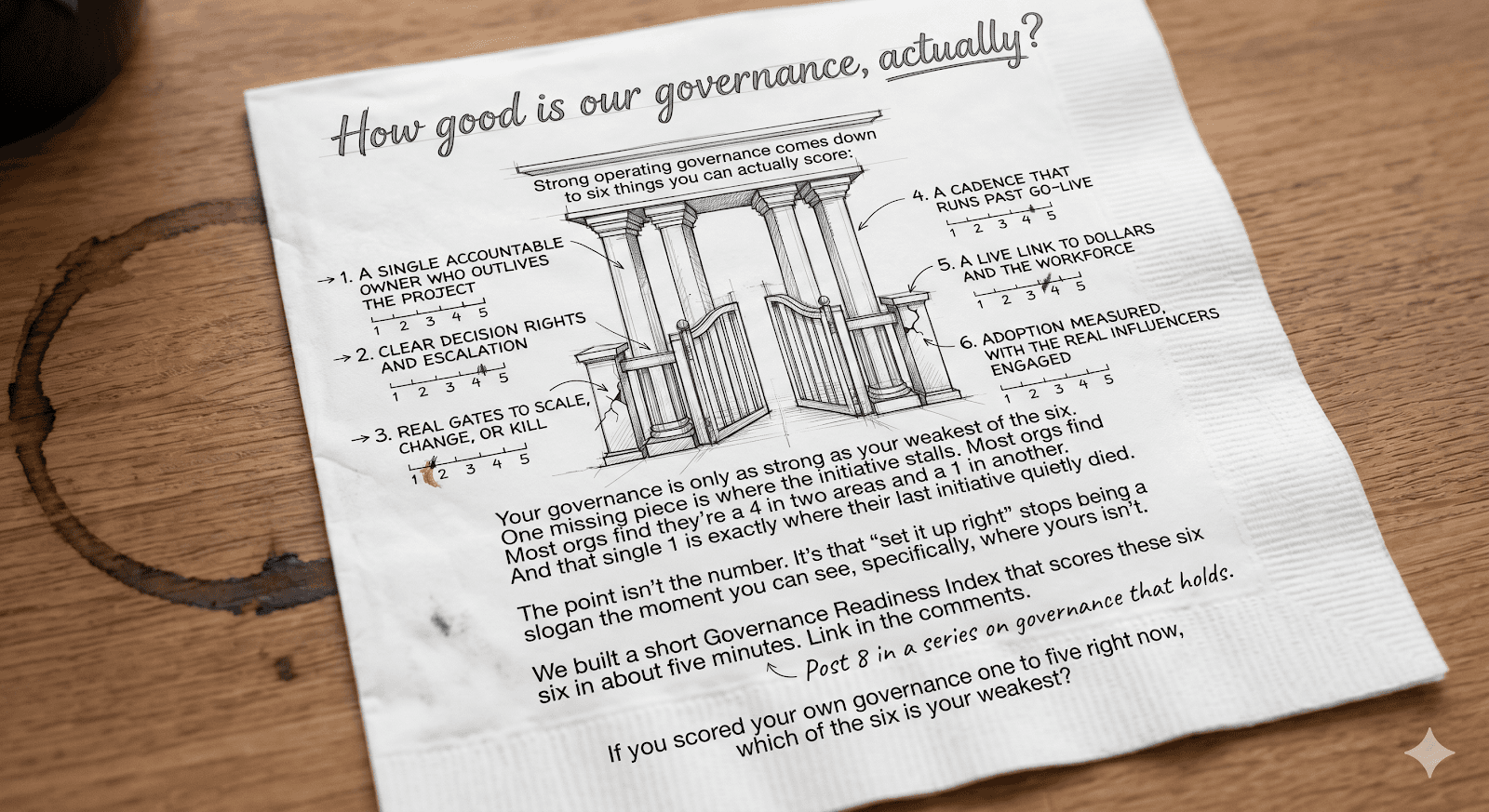
Most organizations have dashboards for everything. Uptime, churn, margin, cycle time, satisfaction scores. Yet the single factor that decides whether any of those initiatives survives past launch? That one gets assessed by feel.
Ask a leadership team how strong their governance is and you will get a shrug, a story, and a lot of careful hedging. Nobody has a number. And that matters, because you cannot improve what you cannot see. "Set governance up right" stays a slogan until you can point to exactly where yours is weak.
The Problem With Invisible Governance
Governance failures rarely announce themselves. They show up quietly, months after go-live, when adoption plateaus, when the project team has moved on, when accountability has dissolved back into the org chart. By then, the connection between the governance gap and the outcome gap is hard to trace.
That invisibility is the real risk. Not bad governance, exactly, but governance that no one has ever made measurable. The good news is that it does not have to stay that way. Strong operating governance is not abstract. It comes down to six specific capabilities, each of which you can rate, score, and act on.
Six Capabilities You Can Actually Score
Rate each of the following on a simple one-to-five scale. Be honest. The value of this exercise lives entirely in the accuracy of your answers.
1. A Single Accountable Owner Who Outlives the Project
One name, not a committee. One person who remains responsible for the outcome after the project closes, the implementation team disperses, and the vendor moves on to the next engagement. When ownership is shared, it evaporates. Accountability requires a single point of contact with the authority to act.
2. Clear Decision Rights and Escalation Paths
Everyone on the team knows who decides what, and how a stuck decision moves up. Without this, decisions either stall at the working level or escalate to people who lack context. Both outcomes cost time and erode momentum. Clarity here is not bureaucracy. It is speed.
3. Real Gates to Scale, Change, or Stop
Evidence-based checkpoints that actually function as gates, including the discipline to stop something that is not delivering. Many organizations have milestone reviews on paper. Fewer have the organizational will to act on what those reviews surface. A governance gate only works if there is genuine authority behind it.
4. A Cadence That Runs Past Go-Live
A standing rhythm of review that does not end when the ribbon is cut. Go-live is a beginning, not a finish line. The initiatives that sustain results are the ones where someone is still asking the right questions six months later, twelve months later, two years later. If the review cadence stops, the results tend to follow.
5. A Live Link to Dollars and the Workforce
The initiative stays connected to realized value, not just projected value. And specifically, it stays connected to the labor model, where the majority of that value tends to live in healthcare. When the governance structure loses its line of sight to actual financial outcomes, the initiative drifts from results into activity.
6. Adoption Measured, With the Real Influencers Engaged
You know whether the platform or process is actually being used. And the people the broader network looks to, not just the formal leaders, are part of making it stick. Adoption is not a training event. It is an ongoing social and operational dynamic. Governance that ignores it is governance that will be surprised by the outcomes.
The Weakest Link Rule
Here is what makes this scoring exercise honest rather than flattering. Your governance is only as strong as your weakest of the six. This is not an average. One missing capability is enough to send an initiative sideways, regardless of how strong the others are.
A clear owner, tight decision rights, and a consistent cadence will not save an initiative that was never connected to dollars or adoption. The weakest link carries disproportionate weight, and that is precisely why most governance assessments, the ones that average scores across categories, give organizations a false sense of security.
When organizations actually run this kind of structured assessment, the pattern is strikingly consistent. They score a four in two areas, a three in a couple more, and a one in one. And that single one turns out to be, reliably, exactly where their last initiative quietly lost momentum. The value of scoring it is not the tidy number at the end. The value is that the failure stops being mysterious and becomes specific, visible, and addressable.
Turning a Vague Worry Into a Clear Starting Point
The practical version of this does not require a formal assessment process. Sit your leadership team down, score each of the six out of five, and find your lowest number. That single score is where your next initiative is most likely to stall. Knowing it in advance is the difference between hoping your governance holds and knowing exactly where to strengthen it before you need it to carry weight.
A short Governance Readiness Index built around these six capabilities can complete this scoring in about five minutes and map your position on a maturity curve. The point is not the score itself. The point is that the conversation it surfaces, about ownership, about decision rights, about whether this initiative is actually connected to the outcomes it was supposed to drive, is a conversation most leadership teams have never had in a structured way.
What Comes Next
This framing is part of a broader argument: governance should not be an effort you restart from scratch for every initiative. It should be a system that runs, a durable operating model that connects the platforms you have already invested in to the results you are still trying to realize.
Most health systems are not short on tools or technology. They are short on the connective tissue between governance, process, and adoption. That connective tissue is what turns a platform investment into a labor cost reduction, a retention improvement, a scheduling operation that runs predictably rather than reactively.
The next step is simply making the invisible visible. Score the six. Find your weakest link. And start the conversation about what it would take to close that gap before the next initiative depends on governance that has not been built to carry it.
If your organization is approaching that governance gap, or working through the aftermath of one, that conversation is a good place to start.
Ready to transform your workforce strategy?
Let’s discuss how to build the operating model your organization actually needs.
Book a Consultation