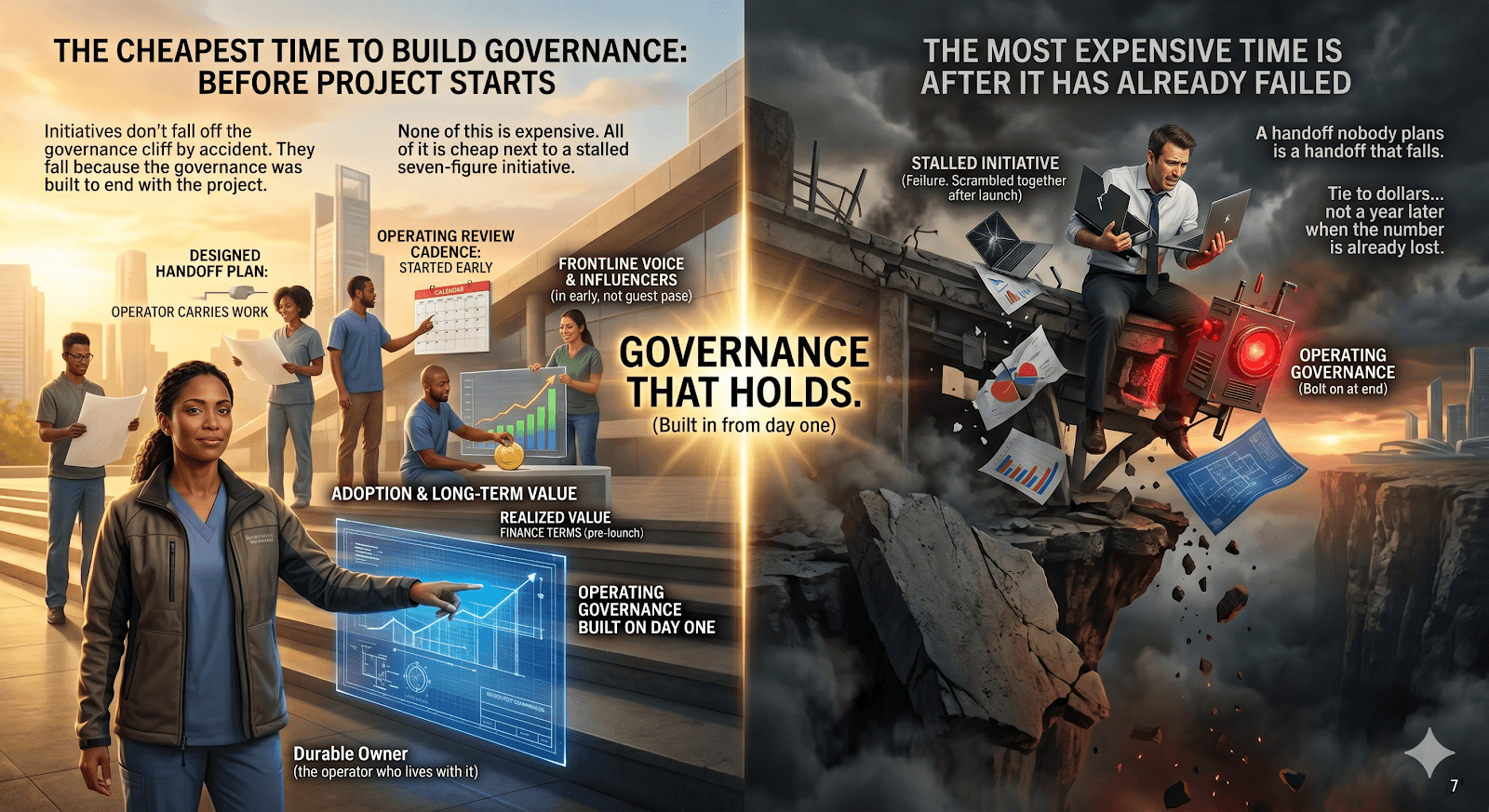
Before a single timeline is built or a kickoff meeting is scheduled, the most consequential governance decisions are already available to you. Most organizations just don't make them.
That's at the center of every initiative that launches successfully and delivers little. The project governance worked exactly as designed. It ended when the project ended, right when the realized value needed the most protection.
So the real question becomes practical: what does it look like to build governance that survives the project? Here is the operator's answer, in five moves, all made before go-live.
The Five Moves That Protect Initiative Value
Move 1: Name the Durable Owner Before the Work Begins
Most projects defer the most important decision they need to make. They name a project manager, stand up a steering committee, and ship the initiative without ever identifying the person who will own the outcome after the project closes.
The durable owner is not the project manager. The project manager's job ends at launch. The durable owner is the operator who has to live with the result, answer for the numbers, and keep the initiative connected to business performance six, twelve, and eighteen months out.
When that person is in the room from day one, accountability runs the full length of the initiative. When the seat gets filled only at handoff, it usually doesn't get filled at all. The work lands quietly on no one, and the value starts draining before anyone notices.
Name the durable owner now. Put them in the room from the start. Everything else builds on that decision.
Move 2: Design the Handoff, Not Just the Launch
Project plans are extraordinarily detailed about go-live. They are almost entirely silent about what happens the week after.
When the project team rolls off and the initiative transitions to operations, that transition needs a design. Who carries the work forward? What do they own? When does the transfer happen, and what does a successful transfer actually look like?
A handoff nobody designs is a handoff that fails. This is the governance cliff in its most literal form. The initiative doesn't collapse because of a bad decision. It drifts because no one decided anything. Documenting the handoff early, on paper, before the pressure of launch sets in, is how you close that gap before it opens.
Move 3: Stand Up the Operating Cadence Before You Need It
The operating rhythm should already have momentum on the day the project closes. Not assembled in a panic six months later when someone notices adoption slipping.
Put the recurring operating review on the calendar while the project is still live. Let the durable owner start chairing it before launch. Give the cadence time to find its footing before it has to carry the full weight of sustaining the initiative.
The goal is continuity, not recovery. When the operating rhythm is already running at go-live, there is no gap for value to fall through. When it gets built retroactively, you are always catching up to a problem that didn't have to exist.
This is one of the most straightforward structural decisions available to any initiative leader, and one of the least common.
Move 4: Tie the Initiative to Dollars From the Start
The business case is written to win approval. Then it gets filed away, referenced occasionally in steering committee decks, and quietly disconnected from the actual operating reality of the initiative.
Reverse that sequence. Before launch, assign a benefits owner, a specific person accountable for tracking realized value. Then establish a simple, consistent method for measuring outcomes in the same terms finance uses. Not a custom dashboard. Not a parallel reporting structure. The same language, the same metrics, the same P&L connection that the CFO already recognizes.
This is what keeps an initiative from drifting into a vague organizational sense that it "probably helped." The cost of building this at the start is a few focused conversations. The cost of trying to reconstruct it later, when someone asks where the return went, is a much harder conversation with much less satisfying answers.
If the initiative is meant to move the needle on labor cost, retention, or operational efficiency, the measurement framework for those outcomes belongs in the project plan, not the post-mortem.
Move 5: Bring the Frontline and the Real Influencers in Early
Adoption designed in holds. Adoption bolted on at launch struggles to take root.
The people who do the work every day carry more influence over whether an initiative succeeds than most project plans account for. And within any workforce, there are informal influencers, the people others watch and follow, who shape how new tools and processes actually get used on the floor.
Identify those people early. Give them a meaningful role in shaping the initiative before it ships. Not a feedback session at the end of design. Actual input that influences how the work gets built.
Resistance discovered at launch is a crisis that consumes time, budget, and goodwill. The same input gathered six weeks earlier is just good design. The difference is sequencing, not effort.
None of This Requires a Bigger Budget
That's the part that tends to surprise leaders. Every one of these five moves is a matter of sequencing and attention, not incremental spend. You are not adding work. You are doing the work in the right order, at the moment when it costs the least and protects the most.
What is expensive is the alternative. A seven-figure initiative that launches well and stalls quietly. An ROI that finance can't find. A year of wondering why adoption never reached the numbers the business case assumed. That is the real cost of governance that was built to end with the project.
The structure is available. Most organizations just build it too late, after the cliff rather than before it.
What Comes Next
The next post in this series makes governance assessment concrete and measurable, with a practical way to score where your governance actually stands today. Not a conceptual framework. A working tool you can use to identify where the gaps are before they become the problem.
If your organization is approaching a major initiative and wants to get the governance structure right from the start, that conversation is worth having early. The five moves above cost almost nothing to build in. They cost significantly more to retrofit.
Ready to transform your workforce strategy?
Let’s discuss how to build the operating model your organization actually needs.
Book a Consultation