Large enterprises have poured millions into Enterprise Resource Planning (ERP), Human Capital Management (HCM), and Workforce Management (WFM) platforms. Yet, most executive teams still cannot answer basic questions about their labor reality. They struggle to identify coverage gaps before they happen. They cannot pinpoint where overtime is truly originating. They lack visibility into whether scheduling is equitable or just convenient.
The technology isn't broken. The operating model underneath it is.
Organizations often treat workforce management as a technology implementation project. They focus on the "go-live" date as the finish line. But this approach ignores a critical reality. Workforce transformation is a cultural and operational shift that happens to require technology. When you layer expensive software over a broken process, you don't get efficiency. You get broken data masquerading as strategy.
To fix this, we have to look at the "Two-Dimensional Trap" that keeps organizations stuck in reactive heroics.
The Two-Dimensional Trap
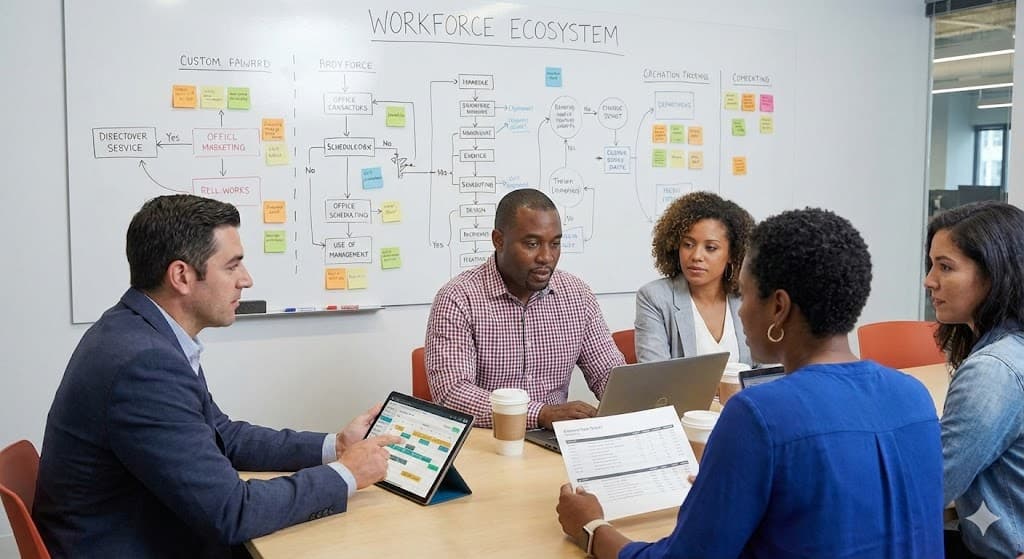
In most complex enterprises, workforce management is fragmented into three disconnected silos. Each group operates with its own data set and its own incomplete picture of reality.
1. Finance lives in the budget cycle.
They measure success through averages and department-level budgets. Their blind spot is variance. Static averages mask the rising complexity of the actual work being done.
2. Operations lives at the unit or team level.
They measure headcount ratios and shift assignments. Their blind spot is cross-departmental demand. They cannot see predictive shifts in volume or the real-time ripple effects of demand across the enterprise.
3. Central Resource Management lives shift-by-shift.
They focus on filling holes and covering absences. Their blind spot is competency. They are tasked with filling slots without visibility into the specific skill intensity required for those tasks.
This is the Two-Dimensional Trap. You have three groups operating in isolation. The result is mixed messages, shadow decisions, and expensive rework. Leaders set a strategy, but what is actually executed is local optimization.
Why "Go-Live" Often Leads to "Shelf-Ware"
Because these groups are disconnected, the technology they buy never delivers the promised ROI. We see it repeatedly. Systems end up underused, distrusted, or abandoned post-implementation.
This happens because strategy fails to execute when governance isn't strong enough to anchor it.
In the absence of a strong operating model, the organization relies on heroics to keep the doors open. Managers create workarounds. The system functions not because it is healthy, but because individuals are sacrificing themselves to bridge the gaps.
This leads to compliance theater. The metrics on the dashboard might look green, but they reflect optimism rather than the reality on the ground.
Rewiring the Organizational Nervous System
Escaping this trap requires a deliberate shift. We need to stop optimizing the plan and start optimizing the people system.
A healthy organization functions like a nervous system. The signal is unambiguous, and the synapses transmit without friction. SynapseShift calls this the SHIFT operating model. It is designed to rewire the organization around real influence rather than just the org chart.
To achieve this, three things must happen:
1. Establish Signal Clarity (The Strategy)
We must redefine which signals matter. Organizations need to move away from static ratios and toward real demand signals. This means aligning the workforce strategy to the operational model so that labor cost and quality reinforce each other instead of competing.
2. Protect Signal Integrity (The Data)
You cannot build intelligence on ungoverned data. Organizations need to integrate their ERP, HCM, and WFM platforms to create a Multi-Dimensional Model. This ensures that what finance sees matches what operations experiences. It prevents broken data from driving the P&L.
3. Accelerate Signal Speed (The Network)
Traditional change management fails because it assumes influence follows the org chart. It doesn't. To get decisions to move fast enough to matter, you have to identify who actually drives adoption. By using tools like Organizational Network Analysis (ONA), leaders can map the real synapses of their organization and route change through the people who are actually trusted.
From Static Planning to Living Strategy
The goal is to move from fragmented, reactive execution to predictable performance.
When you fix the operating model, you stop relying on lag measures and workarounds. You start operating with a Dynamic Decision Engine that uses predictive staffing and demand-based budgeting.
Stop asking which software will fix your labor costs. Start asking if your operating model is healthy enough to support the answer.
Ready to transform your workforce strategy?
Let’s discuss how to build the operating model your organization actually needs.
Book a Consultation