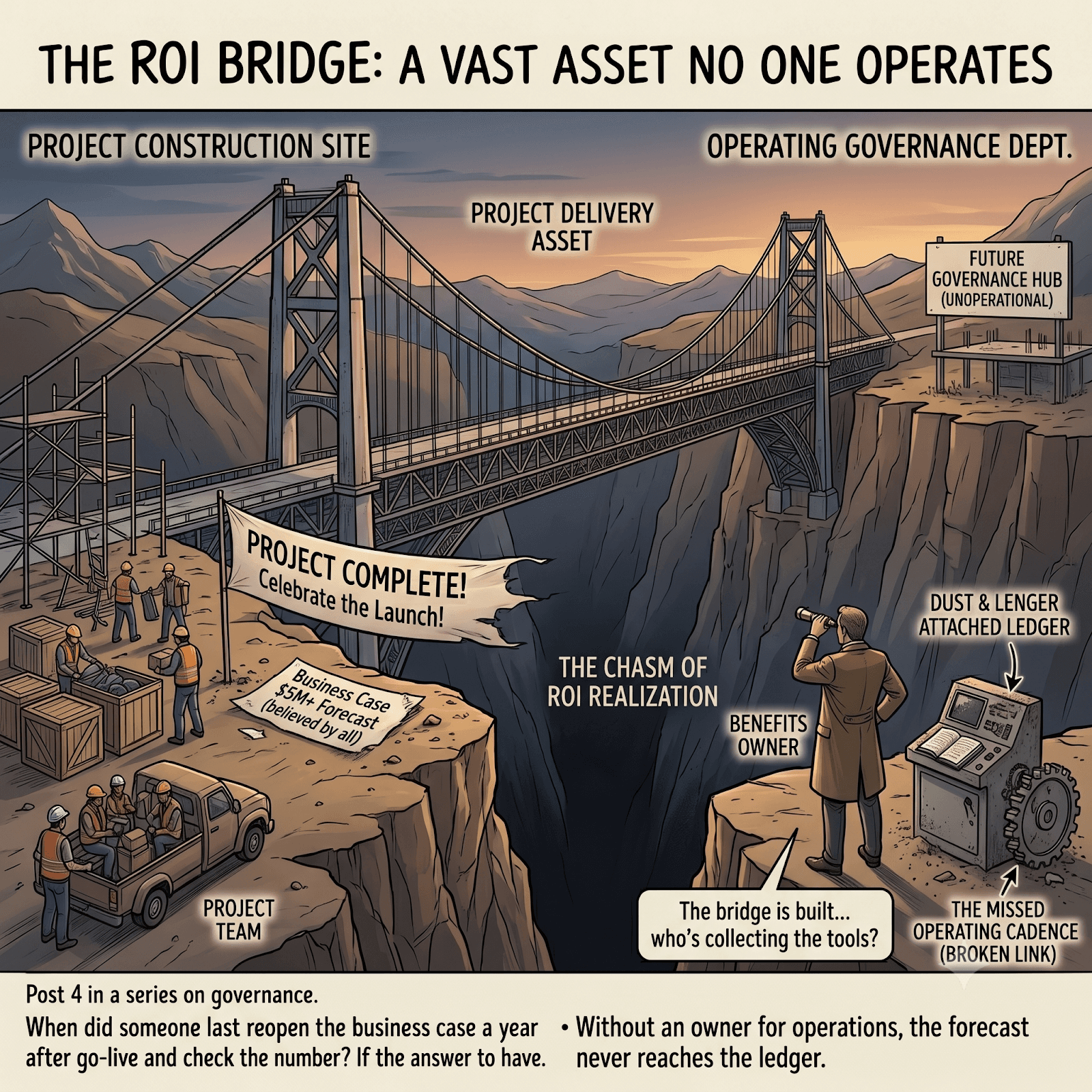
The business case was compelling. Finance signed off, leadership aligned, and the project launched with momentum. Then something quiet happened on the way to the P&L.
The Business Case That Goes Into a Drawer
Every significant initiative gets approved on a number. A business case promises a return: hours saved, costs avoided, revenue unlocked, capacity freed. Finance scrutinizes it. Leadership signs off. The project begins.
Then the project finishes. The team celebrates a successful go-live. And the business case gets filed away. Nobody opens it again.
The savings were real. They simply never reach the P&L.
This is not an edge case. It is the norm. And it is the part of the governance conversation that tends to make CFOs go very quiet.
The Data Is Hard to Ignore
Only about one in five organizations fully realizes the benefits projected from a major initiative. Roughly four in ten capture less than half. Because the shortfall rarely appears as a line item anywhere, no single person is accountable for it. The money does not disappear dramatically. It leaks, slowly, in a place no one is watching closely enough.
It is worth being precise about why this happens, because the answer is not what most leaders expect.
The technology usually works. The project usually delivers what it promised. The gap is not in the build. It is in the handoff. Finance approved the number. Operations delivered the project. And no one owned the space in between, where projected value was supposed to convert into realized value.
That space does not close itself.
The Space Between Approval and the P&L
That gap has an owner only when operating governance puts one there. This is a critical distinction. Project governance gets initiatives across the finish line. Operating governance is what determines whether the value from those initiatives actually lands in the business.
Most organizations invest heavily in the first. Very few build the second with the same intentionality. And that is precisely where the ROI conversation breaks down.
Operating governance is the function that most directly answers to the CFO, and when it is working well, it does four things no project plan does on its own.
Keep the Business Case Alive After Go-Live
The business case should be a living document, reopened on a defined schedule rather than filed the moment the project closes. The projections made at approval become the benchmark for ongoing review, not a historical artifact.
Name a Benefits Owner
Not a committee that nods at a dashboard once a quarter. A specific person, accountable for the number, with the authority and visibility to act when realization is drifting.
Track Realized Value in Finance's Language
Activity metrics tell you whether people are using the system. Finance needs to know whether the dollars are landing. Those are different conversations, and operating governance keeps them connected by reporting realized value on a cadence, in the same terms the CFO uses.
Tie the Initiative Back to the Labor Model
In most health systems, the largest share of initiative value lives in how work and people change, not in what software does. That is exactly the dimension a technology project tends to treat as out of scope. Operating governance brings it back into scope, permanently.
Strip those four elements away and the return on any initiative becomes what it usually is: a forecast that nobody is responsible for hitting.
Delivered Is Not the Same as Captured
Here is the question that separates organizations that capture value from those that only spend it.
Most organizations measure whether a project was delivered: on time, on budget, on scope. Almost none measure whether the value was captured. Those are two completely different questions, and the distance between them is where ROI quietly disappears.
Consider what that looks like in practice. A workforce platform goes live on schedule. Adoption metrics look reasonable. The steering committee concludes the implementation was successful. Eighteen months later, finance is still seeing the same labor cost patterns the platform was supposed to change. No one connects those two facts because the people who tracked the first question stopped asking the second one at go-live.
Operating governance exists to keep asking the second question long after the first has been answered and celebrated. It is the discipline that walks an initiative all the way from a signed business case to a verified line on the P&L, and it refuses to call the work done until the value actually shows up in the numbers.
What This Means for Leaders Who Approved Major Investments
The most useful question any leader can ask right now is a simple one: When did someone last reopen that business case and check the number against reality?
Not whether the project launched. Not whether the platform is live. Whether the value that was projected at approval has actually been realized, measured in the same terms finance used when they signed off.
If the honest answer is that no one has looked, the return on that investment is still a projection. It has not yet become a result.
That is not a reason for concern. It is a reason to build the governance that closes the gap, before more approved value leaks away in the space between delivery and realization.
Where the Series Goes From Here
This series has now covered the governance cliff, the distinction between project and operating governance, the room where operating governance lives, and the direct connection between governance discipline and P&L outcomes.
The next post turns to the people closest to the work, and why the strongest signal about whether an initiative is actually succeeding often comes from the unit that is working hardest to adapt to it. The frontline view of a failing rollout and the executive view of a successful one are frequently describing the same moment. Understanding why that gap exists is what makes it possible to close it.
The climb back from the governance cliff starts with an honest look at what has been approved, what has been delivered, and what has actually landed. Those three things are rarely the same list.
Ready to transform your workforce strategy?
Let’s discuss how to build the operating model your organization actually needs.
Book a Consultation