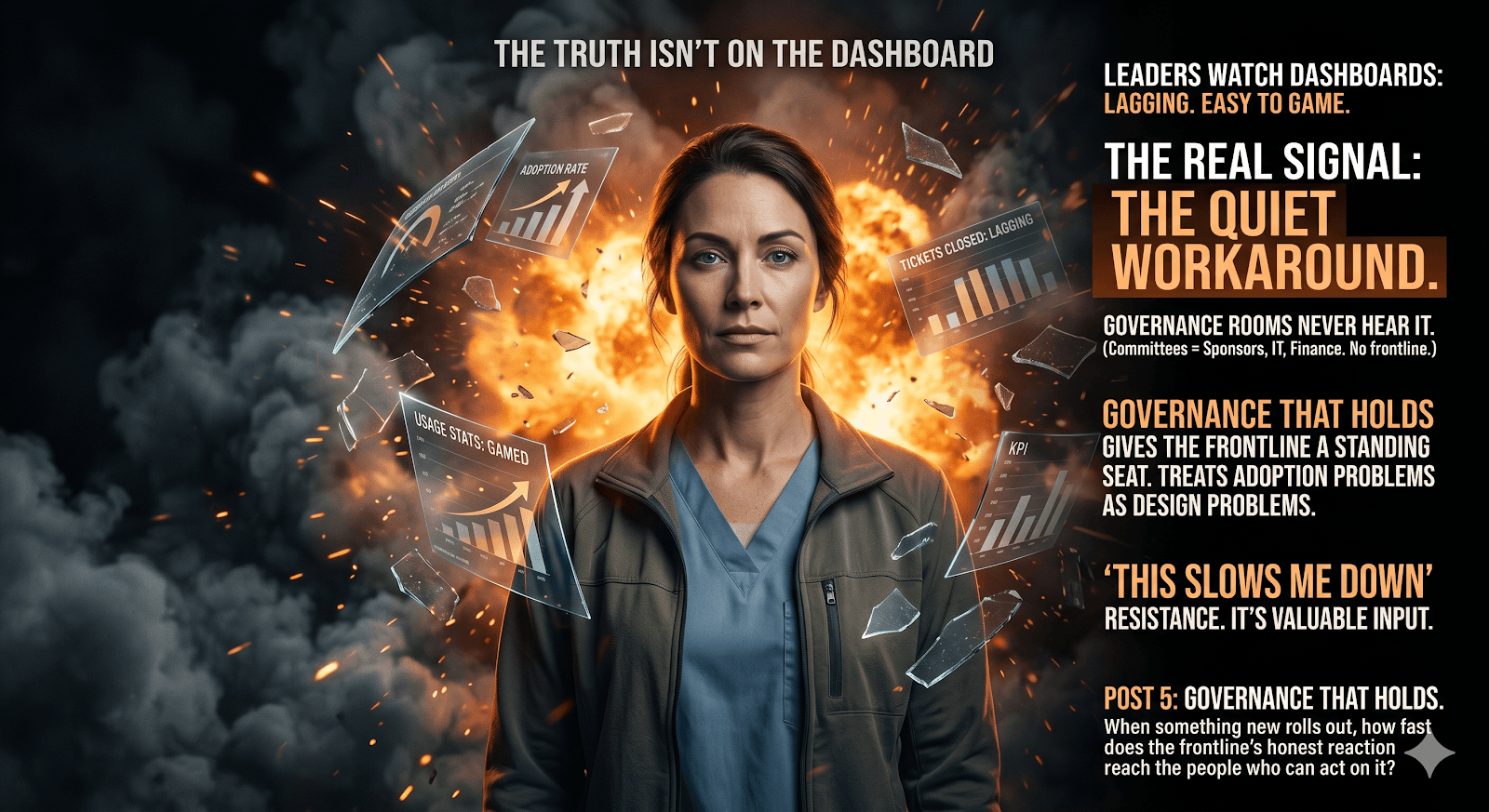
The dashboard looked clean. The initiative was already unraveling.
Most governance structures are built to catch problems after they've compounded. By the time a metric moves, the damage is months old and the workaround is permanent. The organizations that actually hold their initiatives together aren't watching different dashboards. They're listening to a different signal entirely.
The Signal Leaders Miss Most Often
Leaders tend to govern from lag indicators. Adoption rate, login counts, tickets closed, milestones hit. These numbers feel like accountability. And they do serve a purpose. But they share two structural weaknesses: they lag, and they're easy to make look good.
The earliest, most honest signal lives somewhere else entirely. It lives in the unit that has quietly started working around the new way of doing things, because the new way doesn't fit how the work actually happens.
That workaround is the truest early warning an initiative is losing ground. It surfaces long before any metric moves. And in most organizations, it never makes it into the room where decisions get made.
The Room That Wasn't Built to Hear It
Here's the structural gap, most governance bodies are built with IT, finance, and senior leaders. All necessary voices. But often nobody in that room actually does the work the initiative changed.
So the signal that best predicts whether an initiative will hold, the lived reaction of the people using it daily, has no formal path into the governance conversation. The committee ends up governing from a model of the work rather than the work itself.
That gap isn't a personnel problem. It's a design problem. And it compounds quietly. By the time frontline frustration becomes a number a sponsor notices, the goodwill is gone and the workaround is permanent. The organization has already decided what it thinks about the initiative. The governance committee just hasn't heard yet.
Adoption as Design, Not Compliance
Governance that holds over time does two things differently from governance that gradually loses grip.
First, it gives a frontline voice a standing seat with real influence, not a guest appearance scheduled for optics. There's a meaningful difference between inviting someone to observe a governance meeting and structuring the meeting so their input actually changes decisions. The former is box checking. The latter is how you close the gap between the designed process and the real one.
Second, it treats adoption challenges as design signals rather than compliance problems.
That distinction carries more weight than it might seem. When a nurse, a scheduler, or a frontline supervisor says "this slows me down," the instinctive institutional response is to push harder on training, reiterate expectations, and track completion rates more closely. That response treats the problem as a people problem.
The stronger response is to treat that sentence as the most valuable governance input of the quarter. It's telling you that the design and the real work have drifted apart. The fit is off. And the fix isn't more training. The fix is better design informed by the people closest to the work.
Resistance is usually information, not defiance. Organizations that govern well have built structures that know the difference.
Your Most Challenged Unit Is Your Best Instrument
There's a counterintuitive principle worth leaning into here. The part of the organization having the hardest time with an initiative is often the most valuable source of governance signal, precisely because it surfaces the gaps everyone else is quietly papering over.
The unit working around the system isn't the problem. It's the diagnostic. Govern toward it. Listen to it with genuine curiosity. Design with it, not just for it. Do that, and you fix issues while they're still cheap to fix, before they calcify into permanent workarounds and eroded trust.
Ignore it, and you confirm the lesson the rest of the organization is already absorbing: that the new way was decided somewhere they don't sit, by people who don't live the reality. That lesson spreads faster than any adoption mandate.
What "Governing Toward the Work" Actually Looks Like
This isn't abstract. In practice it means a few concrete things:
- Frontline representation with decision influence, not just advisory status, built into the governance cadence from the start
- A standing agenda item specifically for surfacing operational friction, not just milestone status
- Rapid-loop feedback cycles that connect what's heard in the field to what gets adjusted in the design, with visible follow-through so contributors see their input land
- Explicit permission to name workarounds without it being treated as a compliance failure
These aren't complicated structural changes. But they require a governance philosophy that treats the people doing the work as the authoritative source on whether the work is actually working.
The Pattern That Separates the Ones That Stick
The initiatives that hold over time share a consistent characteristic. The people doing the work had a real hand in governing it. Not as a checkbox. Not as an end-of-project validation survey. As ongoing participants in a governance structure designed to hear them.
The initiatives that quietly die share a different characteristic. They were governed entirely from a room those people never entered.
That's not a technology problem. It's not a training problem. It's a governance architecture problem. And it's more solvable than most organizations give themselves credit for, because the ingredients are usually already there. The frontline knowledge exists. The willingness to engage exists. What's often missing is the operating model that connects them to where decisions get made.
The Takeaway
If your governance structure is built primarily from lag indicators and populated primarily by people who don't do the work the initiative changed, you have an opportunity to close a meaningful gap before it costs you.
Start with a single question: Does the person doing the work have a real path into the conversation where decisions get made? If the honest answer is no, that's where the redesign begins.
The next layer worth exploring is the network beneath the org chart, the informal influencers who actually decide whether adoption spreads or stalls. That's where the governance conversation gets more nuanced, and more useful.
Ready to transform your workforce strategy?
Let’s discuss how to build the operating model your organization actually needs.
Book a Consultation