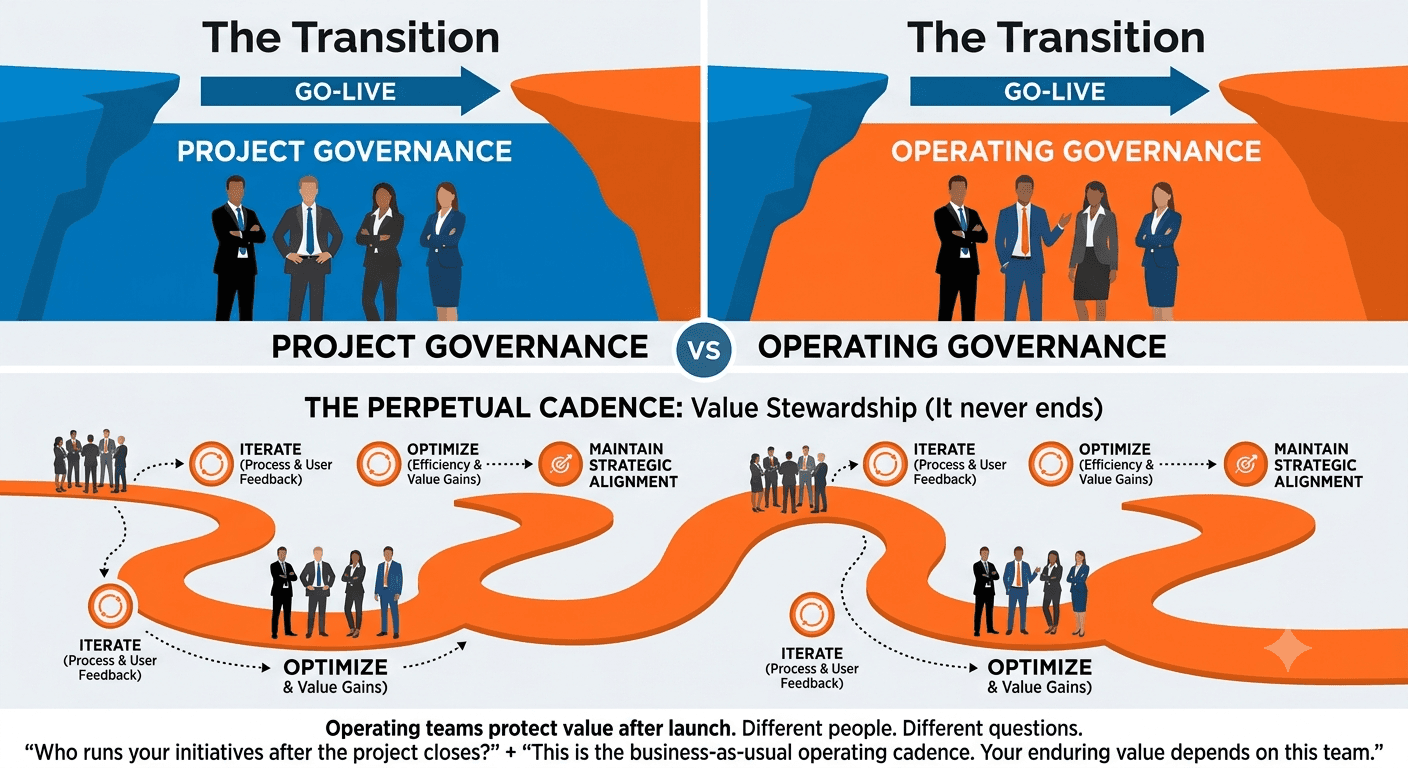
Most health systems launch their workforce platforms successfully. Then, quietly, the value starts to drift. The governance that drove the project closes down, the committee disbands, and no one is quite sure who owns the outcome anymore. That drift is not inevitable. It is a design problem, and it has a fix.
Two Kinds of Governance, Two Different Jobs
Project governance and operating governance look similar on the surface. Both have owners, meetings, and decision-making structures. But they exist for opposite reasons, and confusing them is one of the most consistent ways health systems leave real value on the table after a go-live.
Project governance exists to deliver. Its questions center on time, budget, and scope. Are we hitting milestones? Are we managing risk to launch? It is built to drive an initiative across the finish line, and once the initiative crosses it, project governance has done its job. It winds down by design. That is not a flaw. That is how it is supposed to work.
Operating governance exists to run. Its questions are different in kind. Is this still creating value? Is adoption holding across the organization? Who is accountable for the outcome now that the project is over? What needs to shift as the business changes? Operating governance has no finish line, because the thing it governs has no finish line. It is the standing system that keeps value alive.
Most organizations invest heavily in the first and never formally stand up the second. So the moment the project closes, the only governance they ever built closes with it. That is the governance cliff.
Look at Who Is in the Room
The fastest diagnostic for which kind of governance you actually have is straightforward: look at who sits on the committee.
The Project Steering Committee
A typical project steering committee is built from the PMO, IT, the implementation vendor, and an executive sponsor whose attention will move to the next initiative the week after go-live. That is exactly the right group to deliver a project. It is the wrong group to sustain an operation.
These are people oriented toward a finish line. Their incentives, their metrics, and their attention spans are calibrated to delivery. Once delivery happens, they are already moving. Asking this group to also govern ongoing operations is asking them to do something their structure was never built to do.
The Operating Governance Body
An operating governance body needs a different cast entirely.
- A single durable owner who does not disappear when the project ends and who carries the outcome as a standing responsibility
- The operations leader who lives with the results every day and can connect governance decisions to what is actually happening on the floor
- Finance, present and engaged, so the initiative stays tied to real dollars rather than a business case no one revisits after approval
- A frontline voice that can tell you honestly whether the platform is being used, not just whether it was deployed
Different room. Different cadence. Different reason to exist. When an organization tries to run an operation with a committee designed to finish a project, the outcome is predictable. Decisions slow down. Accountability blurs. Adoption erodes. The cliff arrives.
The Handoff That Has to Be Planned
The organizations that hold their value past launch make one deliberate move. Before the project ends, they stand up the operating governance that will outlive it.
They name the durable owner. They define the decision rights that will carry forward. They set the cadence, the meeting rhythm, the escalation paths, and they hand the outcome to the people who will live with it, not the people who built it.
This sounds straightforward, and in principle it is. In practice it requires someone to plan it explicitly, because it will not happen on its own. The project team assumes someone else will carry the work. The operations team assumes the project team is handling the transition. No one does. The value slides off the cliff while everyone is still celebrating a successful launch.
What a Planned Handoff Includes
A deliberate transition from project governance to operating governance addresses a few specific things:
- Named accountability: One person owns the outcome, not a committee, not a shared responsibility across teams
- Defined decision rights: Clarity on what gets decided at the operating level versus what escalates, and to whom
- A standing cadence: Regular touchpoints that are not tied to a project schedule but to the ongoing rhythm of operations
- A connection to outcomes: Metrics that matter after go-live, adoption rates, labor cost performance, retention trends, not just deployment percentages
Without these four elements in place before the project closes, operating governance becomes aspirational rather than functional.
The Bigger Pattern
This is really a story about where organizations direct their governance energy. Implementation phases are visible, funded, and urgently felt. The pressure to go live is real and immediate. Post-launch operations are diffuse, slower to surface, and easier to deprioritize until the cost of deprioritizing them becomes undeniable.
The investment gap that results is not a sign of bad leadership. It is a structural pattern that most project models reinforce without intending to. Project models are designed to end. Operating models are designed to run. Bridging the two requires a deliberate act, not just a well-intentioned hope that continuity will sort itself out.
Organizations that get this right tend to share one characteristic. They treat the handoff from project to operations as a deliverable in its own right, something that gets scoped, resourced, and confirmed before the project closes, not after.
What Comes Next
Naming the distinction between project governance and operating governance is the starting point. The more granular work is building the operating governance body itself, defining exactly who belongs in the room, what decisions they own, and the cadence that keeps an initiative honest long after the implementation team has moved on.
Ask yourself one question before you move on. Who runs your initiatives after the project closes? If you cannot name a person, a cadence, and a decision process, the honest answer is that no one does.
That is the question worth sitting with. Because the good news is that the ingredients are almost always already there. Governance, process, and adoption rarely need to be built from scratch. They need to be connected. And that connection is exactly where the work of holding value after launch begins.
Ready to transform your workforce strategy?
Let’s discuss how to build the operating model your organization actually needs.
Book a Consultation