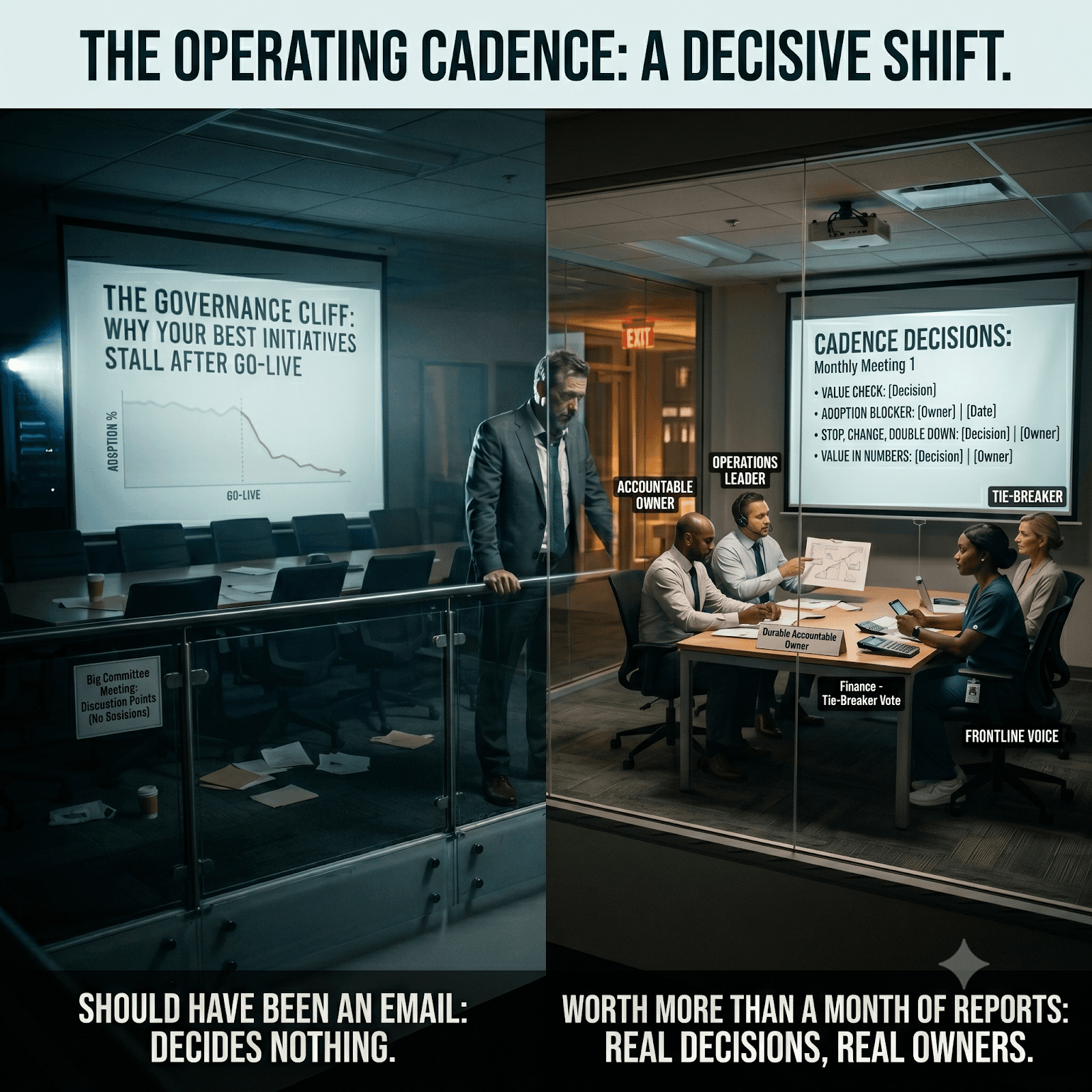
Most governance frameworks tell you governance matters. Almost none of them tell you what the room actually looks like.
That gap is where initiatives quietly lose altitude. You leave the implementation phase a deployed platform, and a project team that is already moving to the next thing. What you often do not have is a clear answer to the most practical question of all: who sits in the operating governance room, what do they decide, and how often do they meet? This post answers that question directly, without abstraction.
The Problem With Most Governance Frameworks
In the last post, we drew the distinction between project governance and operating governance. Project governance is built to end. Operating governance is built to last. That distinction matters, but naming it only gets you so far.
The frameworks most organizations inherit were designed to get something built and launched. They are optimized for delivery milestones, not for sustaining value after go-live. Once the ribbon is cut, the machinery that produced accountability tends to dissolve, and the initiative is left running on goodwill and habit rather than structure.
Operating governance fills that gap. But it only works if you are deliberate about who is in the room and what they are actually there to do.
Who Belongs in the Room
Operating governance fails when the room is too big or built from the wrong people. The instinct in most organizations is to be inclusive, to invite everyone who touched the project, everyone who has a stake in the outcome, everyone who might feel left out if they are not there. That instinct produces committees that are too large to decide anything, too political to challenge anything, and too crowded to move quickly.
Keep it small. Five seats is usually right.
The Accountable Owner
One person, not a committee, whose name is attached to the outcome. Shared ownership is a polite way of avoiding ownership. When accountability is distributed across a group, it belongs to no one. The accountable owner is the person who cannot hand this off and walk away.
The Operations Leader
This is the person who lives with the result every day. They feel it directly when the initiative underperforms. They know the difference between what the dashboard says and what is actually happening on the floor. Their presence keeps the conversation grounded in operational reality rather than narrative.
Finance
Finance belongs in the room from the start, not as an auditor at the end of the year. When finance is present throughout, the initiative stays tied to real dollars rather than a business case that gets filed and forgotten. Value that cannot be traced to the P&L is value that will eventually be questioned or cut.
A Frontline Voice
This is the seat most committees leave empty. It is also the one that sees the cliff first. The frontline voice can tell you whether the initiative is genuinely being used, not just whether it was deployed. Deployment and adoption are not the same thing, and only one of them produces outcomes. Someone close to the work knows which one you actually have.
The Clear Decider
Every recurring governance structure needs one person who breaks a tie so the group never stalls. This does not have to be the most senior person in the room. It has to be a clearly designated role that everyone understands and respects. Without it, difficult decisions get deferred, and deferral is how value leaks.
Who Is Not on the List
Notice who is absent by design. The vendor. The PMO that ran the project. The executive sponsor who is already three initiatives down the road. Each of them was exactly right for the build phase. None of them are who you need to run the operation. The skills that get something launched are different from the skills that keep it producing.
What They Actually Decide
The fastest way to tell whether a meeting is governance or not is to look at what comes out of it. Operating governance produces decisions, not updates.
A real agenda sounds like this:
- Is the initiative still delivering the value we committed to?
- What is blocking adoption, and who owns the fix?
- What do we stop, change, or invest more in?
- Where did the value show up in the numbers, and where did it not?
Every item leaves the room with three things: a decision, an owner, and a date. If a meeting ends with a round of status reports and no decisions, you did not govern anything. You held a recap. Recaps do not keep value alive. They document what already happened and create the comfortable impression that someone is paying attention.
The distinction is not subtle once you know to look for it. Ask anyone who left your last governance meeting what decision was made. If they struggle to answer, you have your diagnosis.
The Cadence That Keeps It Honest
Operating governance runs on rhythm. Monthly while the initiative is young and still finding its footing, then quarterly once it stabilizes. The agenda stays consistent so the group can track trends rather than reacting to whatever feels most urgent that week. Open items carry forward with owners and dates until they close.
Consistency is what makes the cadence useful. When the agenda structure changes every meeting, the group spends its time orienting rather than deciding. When the rhythm is predictable, leaders can prepare, comparisons are meaningful, and accountability has somewhere to land.
The Moment Most Organizations Drop the Rhythm
The single most important part of the cadence is that it does not end when the project does. The project handoff is precisely the moment most organizations let the rhythm lapse. The project team disbands, the executive sponsor shifts attention, and the initiative is left without a formal mechanism for oversight. It is also precisely the moment the rhythm matters most.
A cadence that survives go-live is what separates an initiative that compounds value from one that quietly decays. The transition from project to operation is not a finish line. It is the beginning of the work that actually determines whether the investment returns anything.
The Real Test: Two Numbers
You can get a useful read on any initiative's governance health by asking two questions. How many people sit on its governance body? And how many real decisions did that body make last quarter?
When the first number is large and the second is small, you have a committee that meets but does not govern. The initiative may look healthy on a status report. The cliff is somewhere ahead of it.
Small body. Real decisions. Consistent rhythm. Those three properties are not complicated. They are just uncommon, because they require deliberate design rather than inherited habit.
What Comes Next
The next post follows the money. Operating governance only holds if it stays connected to hard dollars, and that connection breaks in predictable ways. We will look at how value that clears an approval process so often fails to reach the P&L, and what governance has to do with closing that gap.
If your organization is navigating the transition from project delivery to operating model, the structure you put in place now will determine what the initiative is worth a year from today. That is worth getting right.
Ready to transform your workforce strategy?
Let’s discuss how to build the operating model your organization actually needs.
Book a Consultation